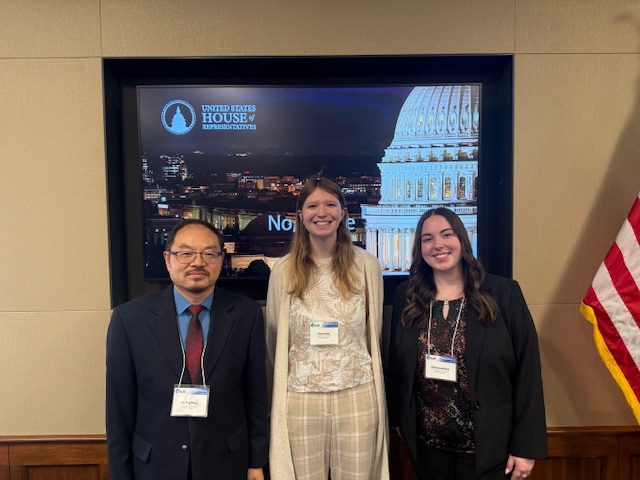
(L to R) Dr. Ping Wang, Chloe Dzuba, and Peyton Lutchkus
RMU MS Cybersecurity students Peyton Lutchkus and Chloe Dzuba presented posters on their cybersecurity team projects at the national INSuRE (Information Security Research and Education) cybersecurity showcase event held at the Rayburn House Office building in Washington DC on December 3, 2025. Their projects and presentations were supervised by Dr. Ping Wang.
RMU is proud to recognize the graduate and doctoral students who presented research at the 2025 International Association for Computer Information Systems (IACIS) Conference in Clearwater, FL in October.
PhD students (L to R): Shadrack Oriaro, Evan Kinney, Amy Kulikowski
Evan Kinney (1st year PhD ISC student) presented Precision Check: A Critical Look at the Reliability of AI Detection Tools, co-authored with Tyler Stewart (1st year PhD student), Dr. Karen Paullet, and Dr. Jamie Pinchot.
Amy Kulikowski (1st year PhD ISC student) presented Protecting the United States Defense Industrial Base against Advanced Persistent Threat Attacks.
Dr. Sushma Mishra and Shadrack Oriaro
Shadrack Oriaro (3rd year PhD ISC student) presented Improving Cybersecurity through Explainable Artificial Intelligence: A Systematic Literature Review, co-authored with Dr. Sushma Mishra.
Peyton Lutchkus (BS/MS Cybersecurity student) and Charley Tyrrell (BS Psychology student) presented Behind the Screen: Pyschological Motivations and Mental Health Issues in Cybercriminal Behavior.
Reese Martin and Chloe Dzuba
Reese Martin (MS Cyber Investigations & Intelligence student) presented Facing Your Digital Footprint on College Campuses, co-authored with Dr. Sushma Mishra.
Chloe Dzuba (BS/MS Cybersecurity student) presented Artificial intelligence in Social Engineering: A Literature Review through the Lens of Routine Activity Theory.
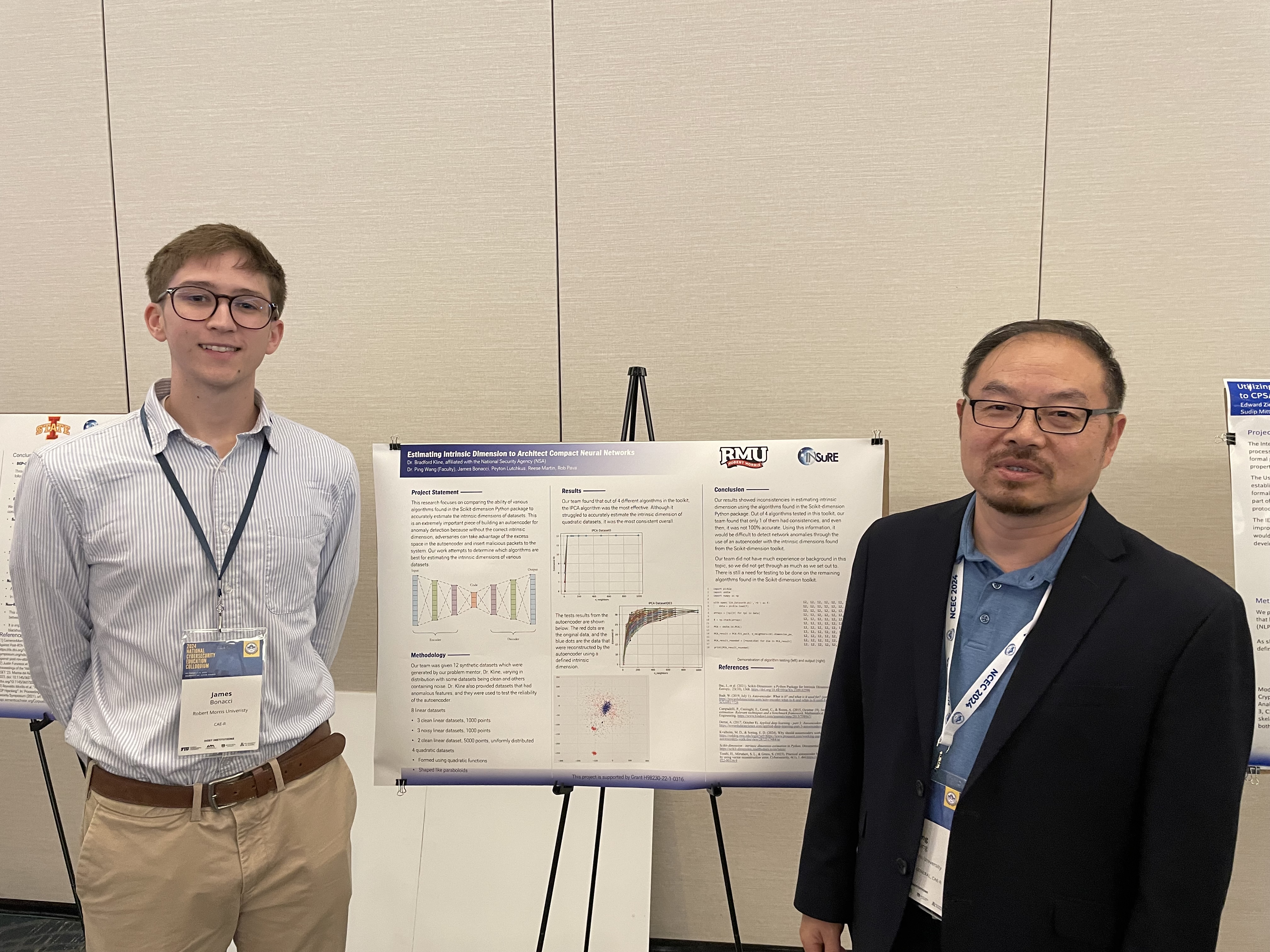
James Bonacci, an NSF SFS student scholar in RMU’s accelerated BS/MS Cybersecurity program, was invited and funded by the national Information Security Research Education (INSuRE) program to present at the 2024 National Cybersecurity Education Colloquium (NCEC) in St. Louis, Missouri during October 7-10, 2024. The presentation was based on a guided team research project on AI/neural network models for security completed in the spring semester by 4 RMU NSF SFS student scholars (James Bonacci, Peyton Lutchkus, Reese Martin, and Rob Pava). Dr. Bradford Kline from the National Security Agency (NSA) served as the government mentor, and Dr. Ping Wang was the RMU faculty supervisor for the team. Thanks to RMU Provost Dr. Joseph Zimmer for his attendance at NCEC in support of RMU cybersecurity programs and students!
Students and Faculty attended the 64th IACIS Annual Conference to present research and to learn about new findings in the field from colleagues.
Robert Pava, Reese Martin, and Dr. Sushma Mishra presented their research: Unveiling Exploitation Potential: A Comparative Analysis of Flipper Zero and Rubber Ducky.
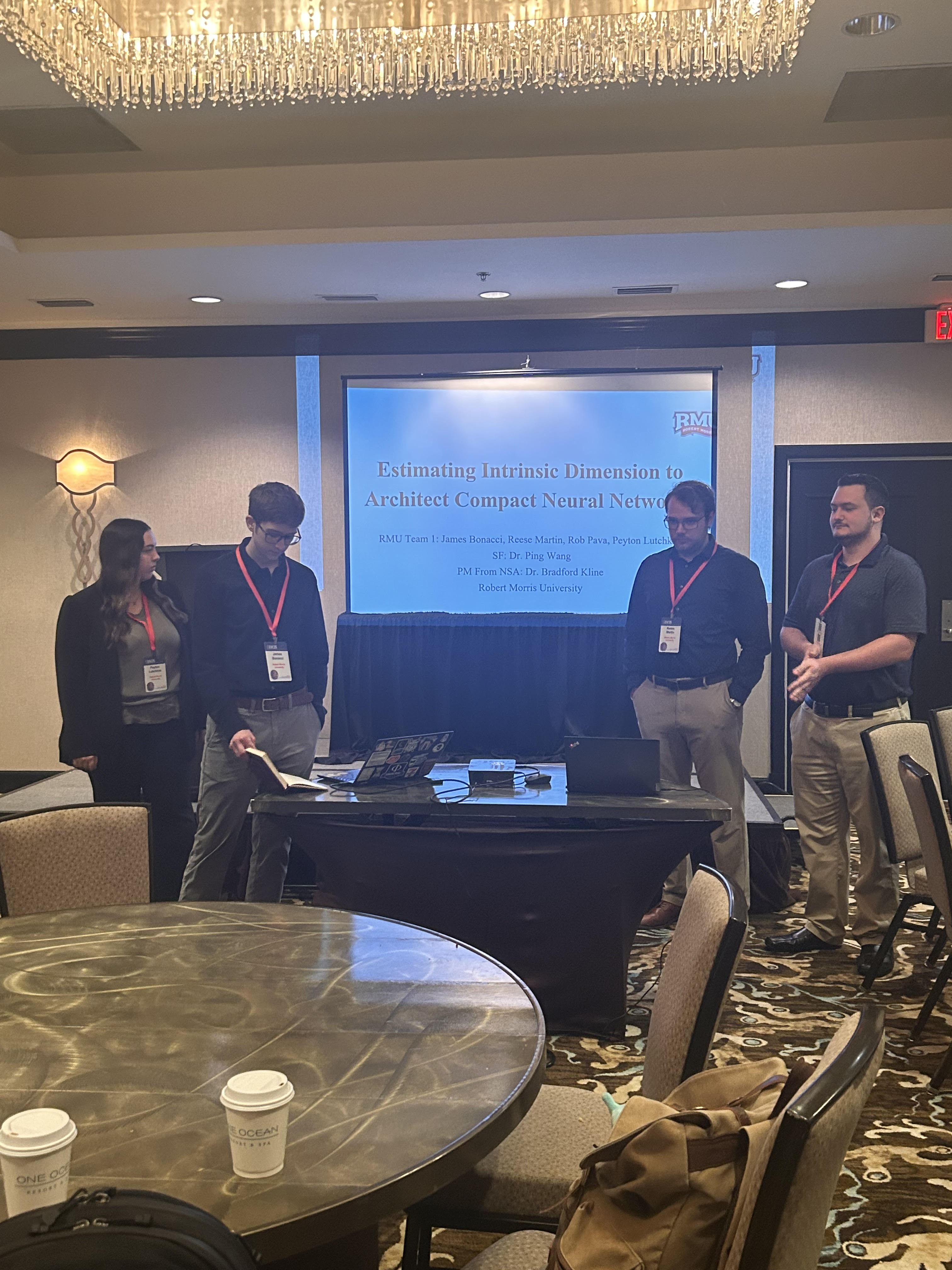
James Bonacci, Peyton Lutchkus, Reese Martin, Robert Pava, Dr. Ping Wang, and Bradford Kline presented their research on: Estimating Intrinsic Dimension To Architect Compact Neural Networks.
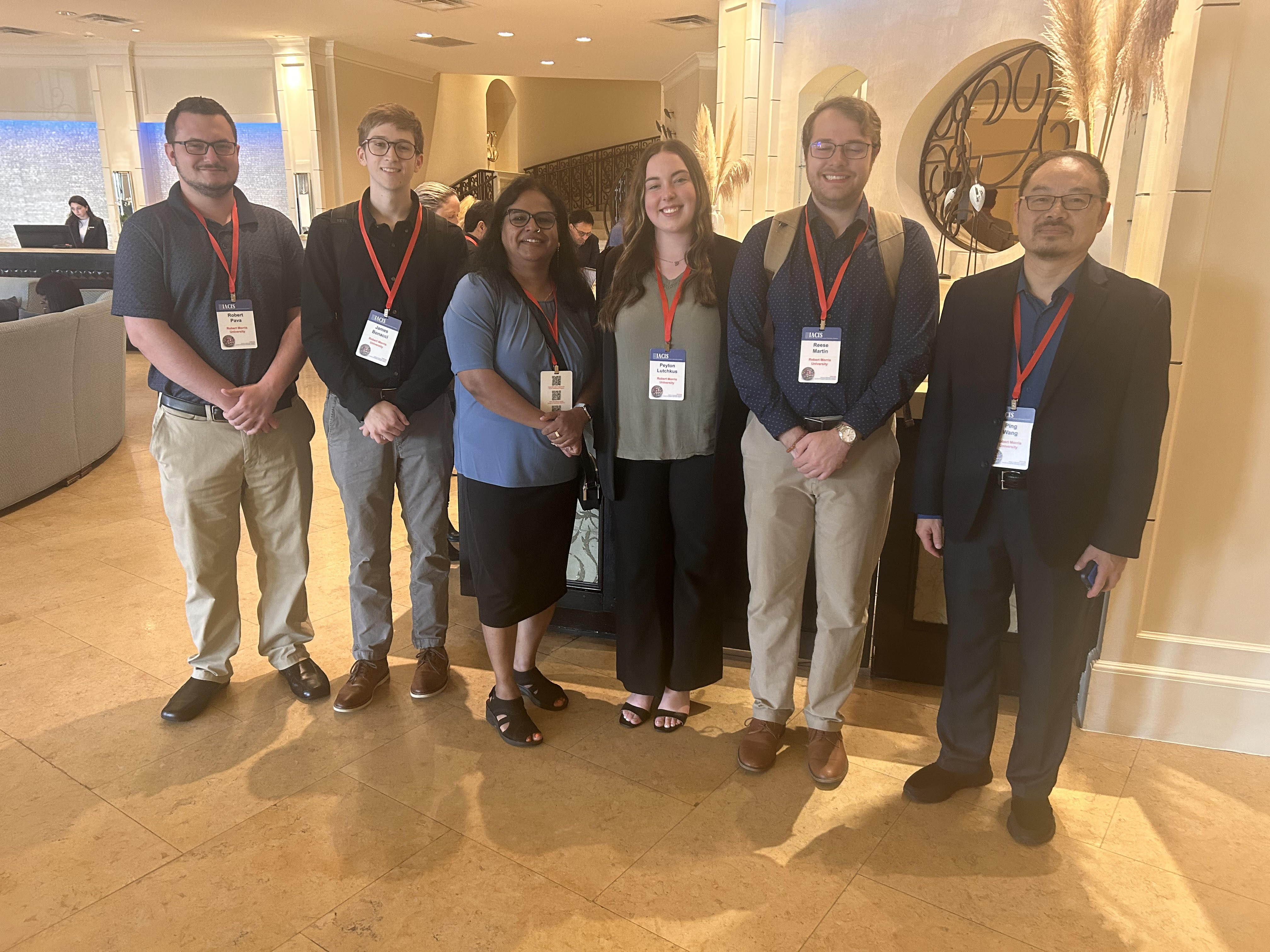
(Pictured: Peyton Lutchus, James Bonacci, Reese Martin and Robert Pava)
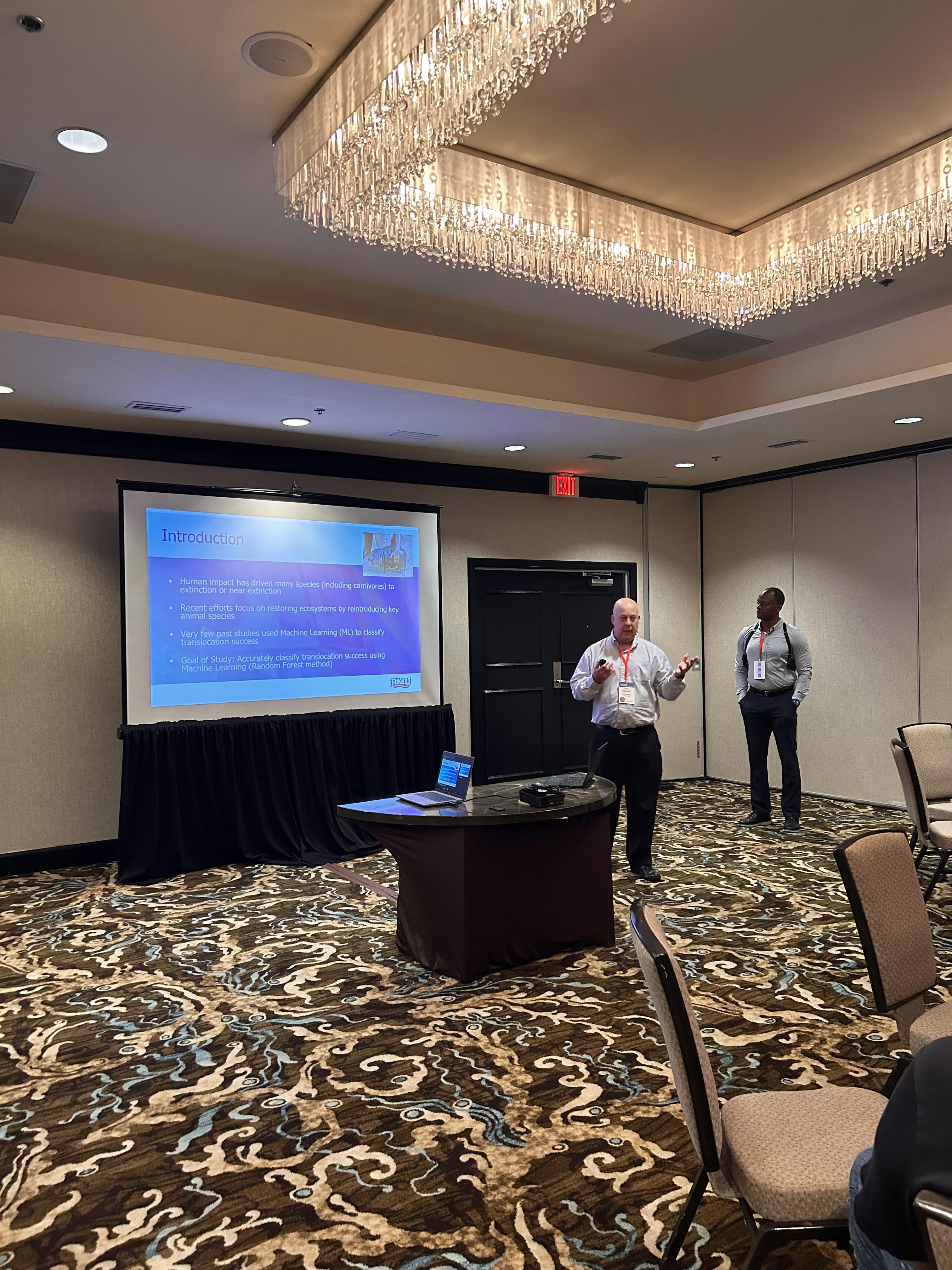
Dr. John Stewart, Dr. G. Alan Davis, and William Glascoe presented their research on Determining Successful Translocation of Large Mammalian Carnivores Using Random Forest Classification. Imran Hossain was also a co-author on this paper.
(Pictured: Dr. John Stewart & Dr. William Glascoe)
William Glascoe presented his research on Human Digital Twin Initiatives. (Dr. Wenli Wang was also a co-author on this paper.)
Dr. Sushma Mishra, Dr. Natalya Bromall, and Dr. Kevin Slonka presented their research on What do High School Students Know About The Field of Cyber Security? A Survey of Perception and Experiences. Dr. Slonka is a graduate of RMU’s doctoral program and currently teaches at Saint Francis University. Dr. Peter Draus was also a co-author on this paper.
(Pictured: Dr. Kevin Slonka and son)
Dr. Ping Wang, and Christopher Johnson presented their research on The Impacts of Generative Artificial Intelligence (ai) In Knowledge Discovery and Generation For Cyber Defense.
(Pictured: Christopher Johnson)
Jing Hua, Dr. Ping Wang, and Peyton Lutchkus presented their research on How Effective Are Large Language Models In Detecting Phishing Emails?
Reese Martin, Robert Pava, and Dr. Sushma Mishra presented their research on Analyzing Machine Learning Algorithms For Antivirus Applications: A Study On Decision Trees, Support Vector Machines, and Neural Networks.
Dr. Natalya Bromall, Dr. Jamie Pinchot and Dr. Sushma Mishra presented their research on Racing To Build Your Ai Skills: Programming Rl Models With Aws Deepracer. Dr. Steve Mancini and Dr. Peter Draus were also co-authors on this paper.
(Pictured: Dr. Natalya Bromall)
Dr. Sushma Mishra, and Dr. Noory Etezady presented their research on Embedding Ai Competencies In A Cyber Security Graduate Program: Identifying Existing Gaps.
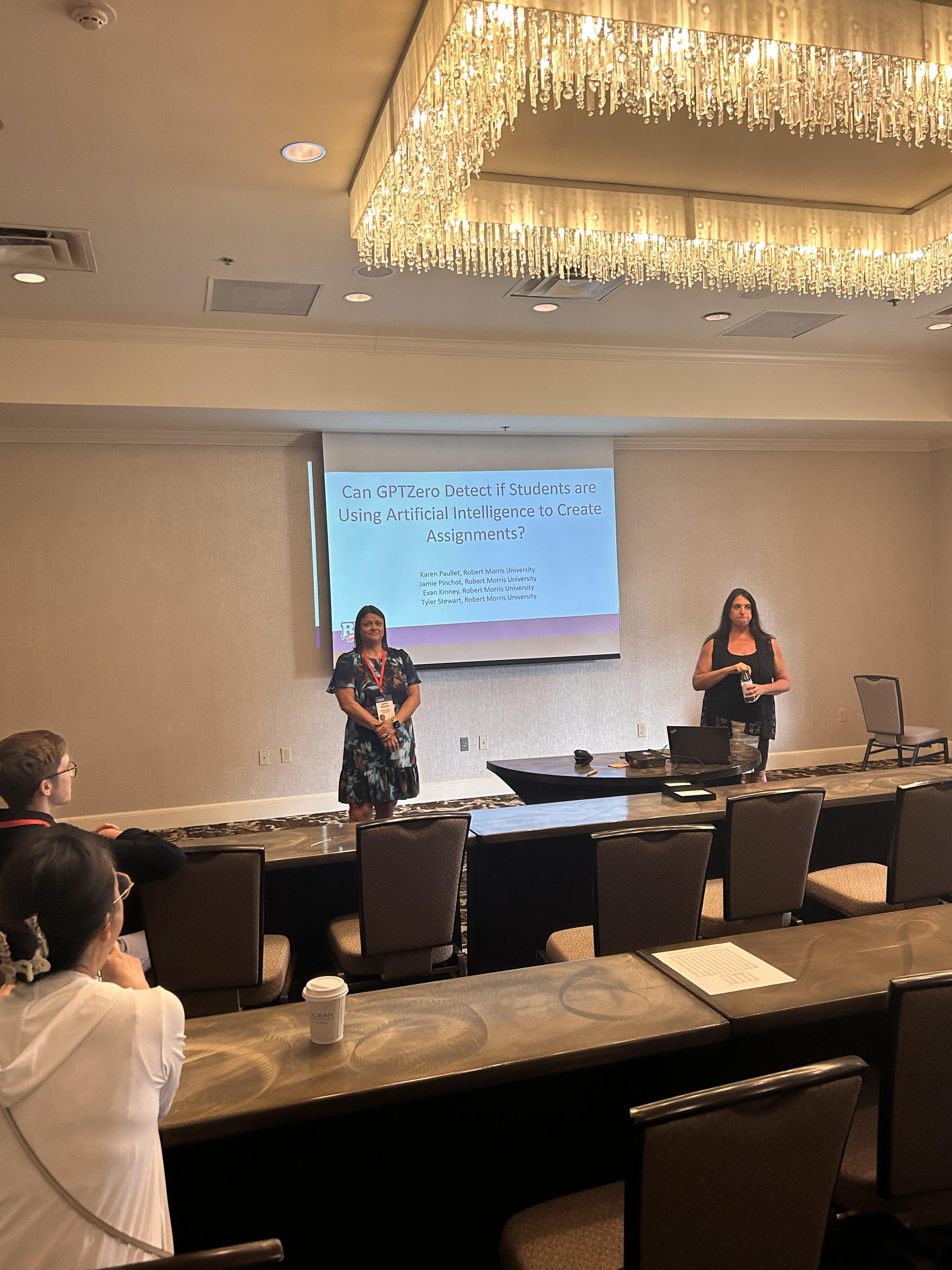
Dr. Karen Paullet and Dr. Jamie Pinchot presented their research on Can Gptzero Detect If Students Are Using Artificial Intelligence To Create Assignments? Evan Kinney and Tyler Stewart were also co-authors on this paper.
(Pictured: Dr. Jamie Pinchot & Dr. Karen Paullet)
A special shoutout to the students who attended as NSF Scholarship for Service:
Peyton Lutchkus, James Bonacci, Reese Martin, and Robert Pava
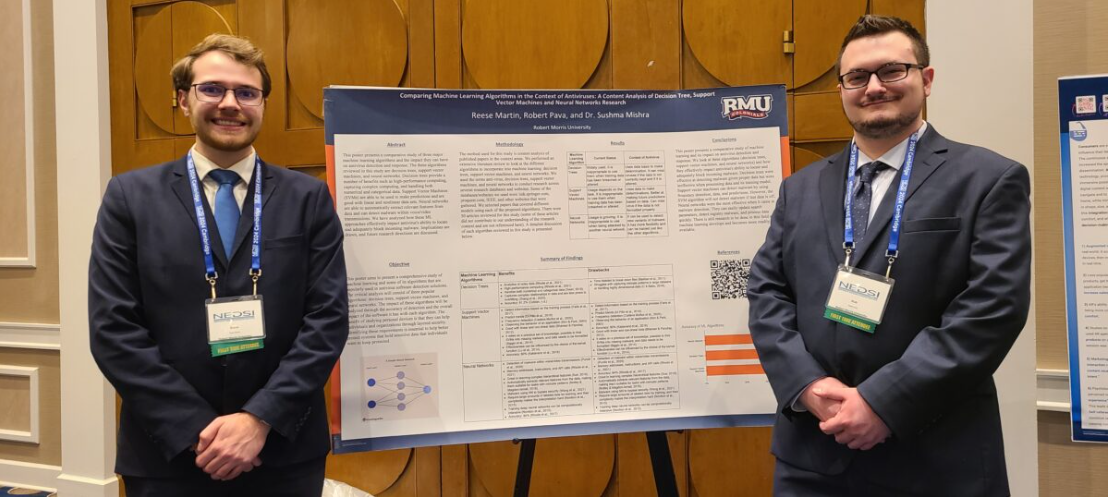
Two NSF Scholarship for Service (NSF-SFS) students, Reese Martin and Robby Pava, presented their research project at the NEDSI conference this month. The Northeast Decision Sciences Institute (NEDSI) is one of five regions in the Americas Division of the professional society, the Decision Sciences Institute. This region encompasses the Northeastern United States. NEDSI holds an annual regional meeting each spring.
Their paper was presented in poster format and was titled, “Comparing Machine Learning Algorithms in the Context of Antiviruses: A Content Analysis of Decision Tree, Support Vector Machines and Neural Networks Research.” Authors were Reese Martin, Robby Pava, and Dr. Sushma Mishra (advisor).
Their paper presents a comparative study of three major machine learning algorithms and the impact they can have on antivirus detection and response. The three algorithms reviewed in this study were decision trees, support vector machines, and neural networks. They analyzed how these ML approaches effectively impact antivirus’s ability to locate and adequately block incoming malware. Implications are drawn, and future research directions are discussed.
We would like to congratulate Katrina Haberberger, MS Data Analytics student, whose Honors thesis, The Impact of a Virtual Garden Experience on Caregiver Anxiety, was accepted to the Johns Hopkins University 2021 Richard Macksey National Undergraduate Humanities Research Symposium. Katrina’s research was supervised by her faculty advisor, Dr. Jamie Pinchot. Katrina will present her research at the symposium on April 24-25, 2021.
She will also be presenting her Honors thesis at the RMU Intersections Undergraduate Research Conference on April 23, 2021. The Intersections Conference will be held virtually this year and can be viewed from the conference website.
Katrina’s research focused on studying the impact of experiencing nature virtually on self-reported anxiety. For her study, she collaborated with the local non-profit Hope Grows, featuring their various restorative and healing gardens. Hope Grows is a nature therapy organization in Moon Township, Pennsylvania that seeks to provide respite and recovery from stress to caregivers. COVID-19 has inhibited many caregivers from accessing their gardens, and some may never be able to visit the gardens in person due to the extent of their care receiver’s needs. There is some evidence that virtual experiences of nature can provide stress-relief similar to that experienced in-person, however this has not been well documented for restorative garden environments. The purpose of this research was to understand the way anxiety is impacted for caregivers who experience a virtual representation of the Hope Grows restorative gardens. The results of her study conclude that watching a short, 2-3-minute video of the Hope Grows restorative gardens produces a statistically significant decrease in self-reported state anxiety. As caregivers may experience high levels of anxiety and stress due to the nature of their responsibilities, watching a short video of restorative gardens could be a quick and easily accessible therapy to ensure that those caring for others are also cared for.
Katrina will be graduating in May 2021 with a BS in Statistics and Predictive Analytics, a minor in Alternative Energy and Sustainability, and an MS in Data Analytics. Her research has made an impact on our local community and has been recognized at a national, well-known research conference. Congratulations, Katrina, on this prestigious accomplishment!
You are invited to participate in a survey conducted by Holden Thee as part of his Honors Thesis research. The purpose of this survey is to better understand factors that contribute to password generation. This survey will take approximately 5 minutes to complete.
There are no foreseeable risks associated with this project. There may be no direct benefits from this research. All responses are confidential, anonymous, and responses will only be accessible to the researchers. Your participation is voluntary, and you may withdraw from this project at any time.
A student innovation group, Enactus RMU, is looking for people interested in developing a social media webpage that will allow students to create a network for studying collaboratively. This project will cover the entire development lifecycle: from requirements definition, to deployment and maintenance. Developers will be able to work at their own pace using online collaborative tools. They are looking for anyone who is interested and willing to learn however ideal candidates will have some of the following skills:
1) All developers should have knowledge of the agile development method, knowledge of software documentation best practices, and a willingness to thoroughly document all code.
2) Developers who wish to work on the webpage design should be familiar with web design best practices, and have knowledge of HTML 5, JavaScript, and CSS.
3) Developers who wish to work on the servers should know how to work with Ubuntu Linux (or any Debian based Linux distribution), have skills in JAVA programming, knowledge of MySQL, be familiar with the TCP/IP model, and have an understanding of distributed file system concepts.
The Ninth Annual Intersections Undergraduate Research Conference will take place April 24, 2015 in the Sewall Center. The Honors Program would like to invite students to apply and present their research papers and creative projects.
Student have three options for presenting: 10-Minute Presentation, Poster or 50-Minute Panel Discussion
This conference highlights various disciplines and subject areas. All majors and years are invited to present.
Students will also receive SET undergraduate research credit for presenting at the conference. Students also have the chance to be awarded the distinction of “best paper” or “best poster” from the conference.
The deadline to submit an application to present isApril 1, 2015. Students can find the application here. Additional information about the conference can be found at rmu.edu/urc.
If you have any questions regarding the Undergraduate Research, please do not hesitate and email Lindsey Sobolosky – Honors Program Assistant at Robert Morris University at sobolosky@rmu.edu or call at 412-397-5949.




 CIS @ RMU